Bison Integrated Genomics
The BIG Project
Activity 4
World's First Bison Genome Biobank
Preserving sperm and embryos of wild bison. It acts as an insurance policy in case of natural disasters or potential human related challenges, and unforeseen circumstances that may impact bison populations. Additionally, since bison from distant herds are unable to mingle and mate as times before, it would be possible to introduce more genetic diversity without risk of moving animals and disease transmission.
The Challenge
Due to the introduction of diseases,
the current disease management tactics, and
the challenges of human development, such as roadways and other infrastructure, wild bison are
increasingly isolated from one another.
Additionally, due to the reduction of the bison populations in North America by greater than 99 percent
by the late 1800s,
there has been a dramatic loss of genetic diversity.
This only furthers the harms of 'genetic bottlenecking' or inbreeding of herds, which leads to weakened herd resiliency and the potential of subspecies loss.
The numbers over the years are not increasing as they once were, and wild herds are still unable to reach one another due to a number of factors.
Luckily, there are currently enough
genetically diverse bison and
healthy genetic diversity amongst bison herds
to ensure the survival of the species if actions are taken.
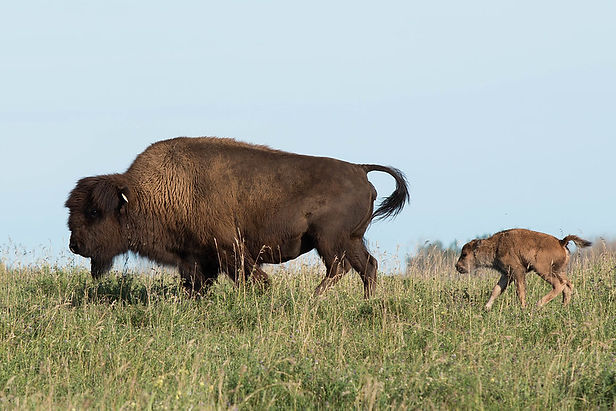
2016 - First bison calf born after transfer of embryo derived from in vitro fertilization
(University of Saskatchewan, National Post, 2016)


The Solution
The creation of the world's first bison genome biobank!
Bison genetics, such as sperm, eggs, and embryos, would be collected from various wild herds and kept 'on-ice' to safeguard for future use or to be sent to other isolated wild herds to increase the genetic diversity
without having to ship and stress a bison!
Wood Buffalo National Park is the largest and most genetically diverse population. However, the challenge is ensuring that isolated small herds beyond the park continue to have healthy diversity and remain disease-free.
Established in 2019, the biobank can safely collect and store semen and embryos from bison across North America and
using in-vitro fertilization, improved genetic diversity could be introduced into isolated herds — safely and efficiently.
Alternatively, genetic material from herds can be kept “on ice” indefinitely - like an insurance policy in case of unforeseen events that impact populations.
Collecting genetic materials is complex, and strict rules and cultural considerations need to be followed.
The team works to ensure that genetic material is free of infectious disease, meaning that samples from bison that carry tuberculosis and brucellosis can be washed free of disease through the techniques the BIG Project has learned.
It’s important that these samples be preserved long-term and shared without moving live animals,
decreasing bison stress levels and
increasing the ability to move genetics
quicker and on a wider scale.
Indigenous partners are central to the creation of the biobank. Collection, storage, and decisions around the use of samples are made and guided by Indigenous partners and local processes.
