Bison Integrated Genomics
The BIG Project
History & Present Challenges
Biologists have estimated that there were around 30 million plains bison and
168,000 wood bison prior to the 20th century. However, by the turn of the century, both plains and wood bison populations were reduced by over 99% to near extinction levels.
By 1896, wood bison population levels dropped to approximately less than 250 bison.
Plains bison during this period also had a dramatic drop in population and also had cattle related diseases introduced into their herds due to farming in their traditional territories.
With this drop in both wood and plains bison, the government of Canada shipped 6000 Plains Bison in the 1920's from Wainwright, Alberta, north to Wood Buffalo National Park. This transfer led to the introduction of those cattle diseases from this herd and mixing of these plains bison into the existing small wood bison population.
In the late 1950's, a small herd of isolated wood bison were rediscovered in Wood Buffalo National Park. 16 of these bison were shipped north to establish the Mackenzie herd and
23 were shipped south to establish the Elk Island National Park herd.
This move was an effort to save the 'genetically pure' wood bison.
However, it was later discovered that this isolated herd had at some point mixed with the introduced, diseased plains bison.
Luckily, the Mackenzie herd remained uninfected.
Sadly, the adults of the Elk Island herd
were found to be diseased and were culled;
fortunately, 11 disease-free calves were saved and hand-reared.
The 11 disease-free calves were used as the founding herd
for 5 of the 9 wild bison herds in existence today.
The introduction of diseases (Bovine Tuberculosis and Brucellosis), the increase of human populations into bison areas, urbanization of natural migration corridors, and
the economic shift in the worldviews of bison being utilized as a commodity
have led to a crisis for bison, with ongoing repercussions felt today.
The BIG Project recognizes the decisions of the past
have left bison with two major challenges:
disease and isolation.
In 2020, the recovery of wood bison in Canada was designated
an imminent threat through the Species At Risk Act, if action is not taken now.
By comparison, plains bison suffered greater losses than wood bison in Canada. By the turn of the 20th century, there were no (zero) plains bison in Canada, and all present wild plains bison herds in Canada came from a remnant group of ~40 left in EINP that escaped capture and transport to Buffalo National Park (BNP) in Wainwright after Canada purchased the largest remaining plains bison population from the Pablo Allard herd in Montana in 1906.
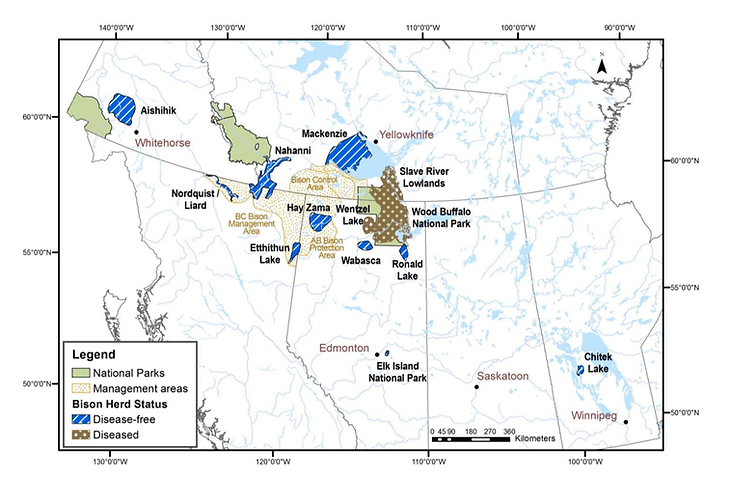
Today, there are around 6000 wood bison in 10 wild herds that are disease-free,
and another 3000 in diseased herds in and around Wood Buffalo National Park.
Without the ability to naturally mingle and reproduce, bison are
at a critical time in history to ensure genetic diversity and population growth
in these isolated herds.
Map of disease-free and diseased herds